Before comparing TROP2 ADC exposure: why a reported AUC changed
On this page
Abstract
Public PK and exposure–response sources for two TROP2 ADCs were examined for a transferable payload exposure target. Reported SG ADC AUC differed 2.136-fold between an older and a 2026 label, while free-SN-38 AUC differed by −5.0%; definitions, models and populations must therefore be distinguished. DAR-based concentration derivation is nonlinear, and the drugs differ in analytes and integration windows. These aggregate sources did not establish a common payload exposure target or potency ranking.
Introduction
Sacituzumab govitecan (SG) and datopotamab deruxtecan (Dato-DXd) both target TROP2. Borrowing an existing drug's payload exposure may look attractive when developing another TROP2 ADC. Before matching units, however, a more basic question comes first: what was measured, and how was “ADC concentration” calculated?
Between an older SG label and the 2026 version, the reported ADC AUC over the first 168 hours increased 2.136-fold, while the reported free-SN-38 AUC changed by −5.0%. This is not evidence that patient exposure doubled over calendar time. Public assessment documents explain changes in derived ADC concentration and the PopPK model.
I examined whether a numerical exposure ranking between the drugs is supportable. These aggregate PK and E–R sources do not establish a transferable payload exposure target or potency ranking. The reasons involve measured versus derived quantities, time windows and outcomes, rather than merely the fact that the drugs differ.
Scope and verification methods
The question is whether published PK and E–R evidence supports a common payload target or ranking across TROP2 ADCs. The context of use is public-data research and discussion of information gaps, not patient treatment or trial-dose selection.
I checked label histories, papers and 2026 assessment documents, then calculated unit conversions and sensitivity of derived concentrations. This is neither PopPK estimation from patient concentrations nor a full reimplementation of the existing models. The plan was fixed after source exploration and before numerical calculation.
Source comparisons and calculations
SG concentration definitions
The 2024 SG PopPK paper measures total and free SN-38 by LC–MS/MS and total antibody separately. SG concentration is derived from conjugated SN-38 under DAR=8. Measured total antibody and this derived SG concentration are different quantities (1).
The 2026 EMA assessment describes an integrated model of total antibody, free SN-38 and total SN-38, deriving SG concentration from a time-varying DAR. It identifies incorporation of DAR as a major contributor to changes in AUC and half-life. It also notes that derived SG concentration is model-dependent and lacks confirmatory data. This is not described as a change in the assays themselves (2, printed pp. 18–20, 34).
Table 1 Reported SG quantities across label versions
| Reported SG label quantity | Older version 18 | 2026 version 20 | Calculated reporting difference |
|---|---|---|---|
| ADC AUC0–168 (ng·h/mL) | 5,640,000 | 12,049,500 | 2.136-fold |
| Free SN-38 AUC0–168 (ng·h/mL) | 3,696 | 3,510 | −5.0% |
| Free SN-38 Cmax (ng/mL) | 98.0 | 108 | +10.2% |
In Table 1, the older version summarizes monotherapy; the current version includes monotherapy and pembrolizumab-combination populations. Models and patient composition also differ (3, 4). The entire 2.136-fold difference cannot be causally attributed to DAR alone. This is not a paired recalculation of identical patient concentration histories under both definitions, and no confidence interval was attached to reporting differences.
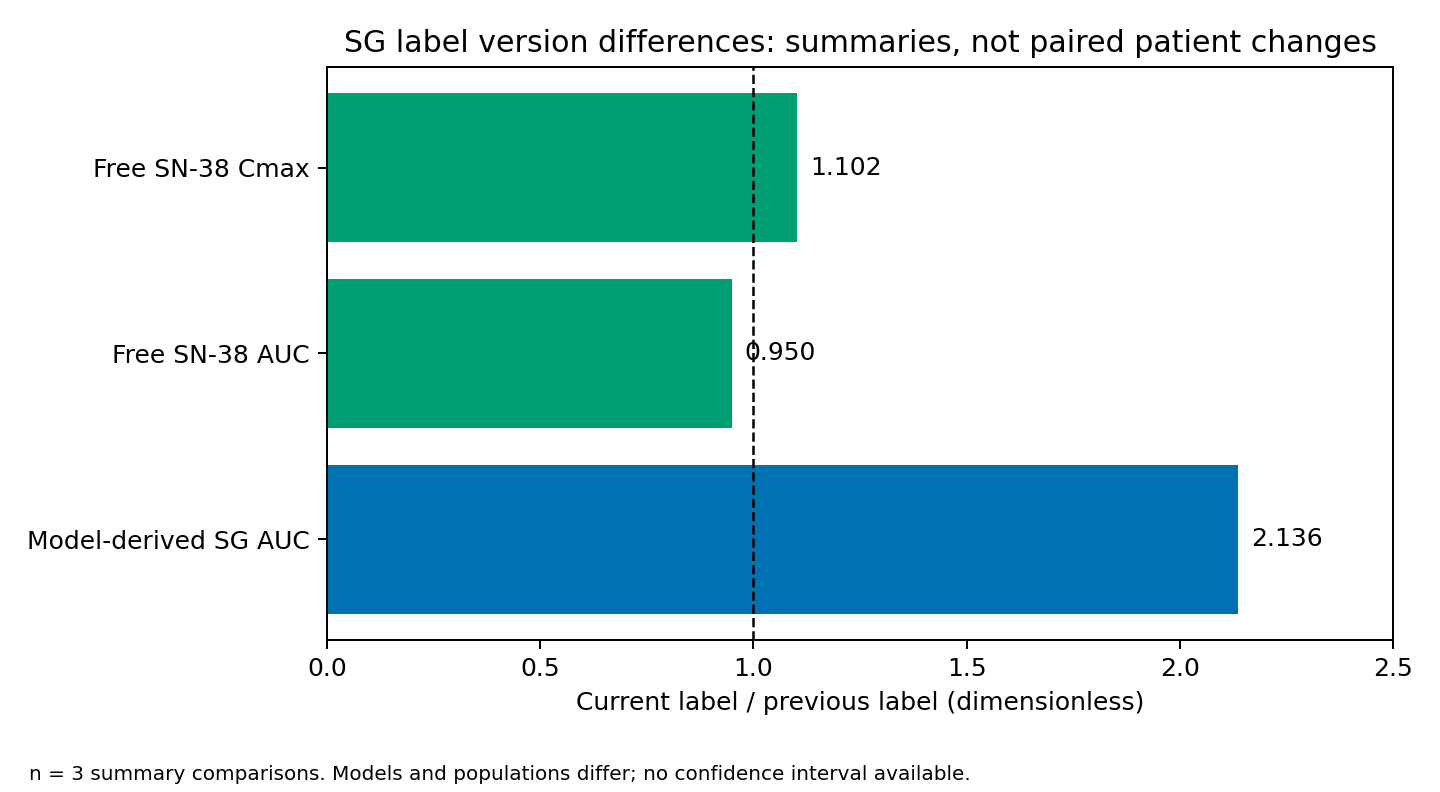
Figure 1. Current/older reported-value ratios. Each ratio compares two reported values for one aggregate metric. The dashed line denotes identical reporting. The figure does not measure a clinical exposure change or improvement in model performance.
Nonlinear conversion through DAR
For molar concentration of conjugated payload \(P(t)\), the two definitions are:
\[ C_{old}(t)=\frac{P(t)}{8},\qquad C_{new}(t)=\frac{P(t)}{DAR(t)}. \]
With the same \(P(t)\), the instantaneous ratio is \(8/DAR(t)\). The integrated ratio is not the reciprocal of a simple time-average DAR:
\[ \frac{AUC_{new}}{AUC_{old}} =8\frac{\int P(t)/DAR(t)\,dt}{\int P(t)\,dt}. \]
This is a molar-concentration identity, not a cross-drug potency conversion. Moving to mass concentrations also requires molecular weights and analyte definitions.
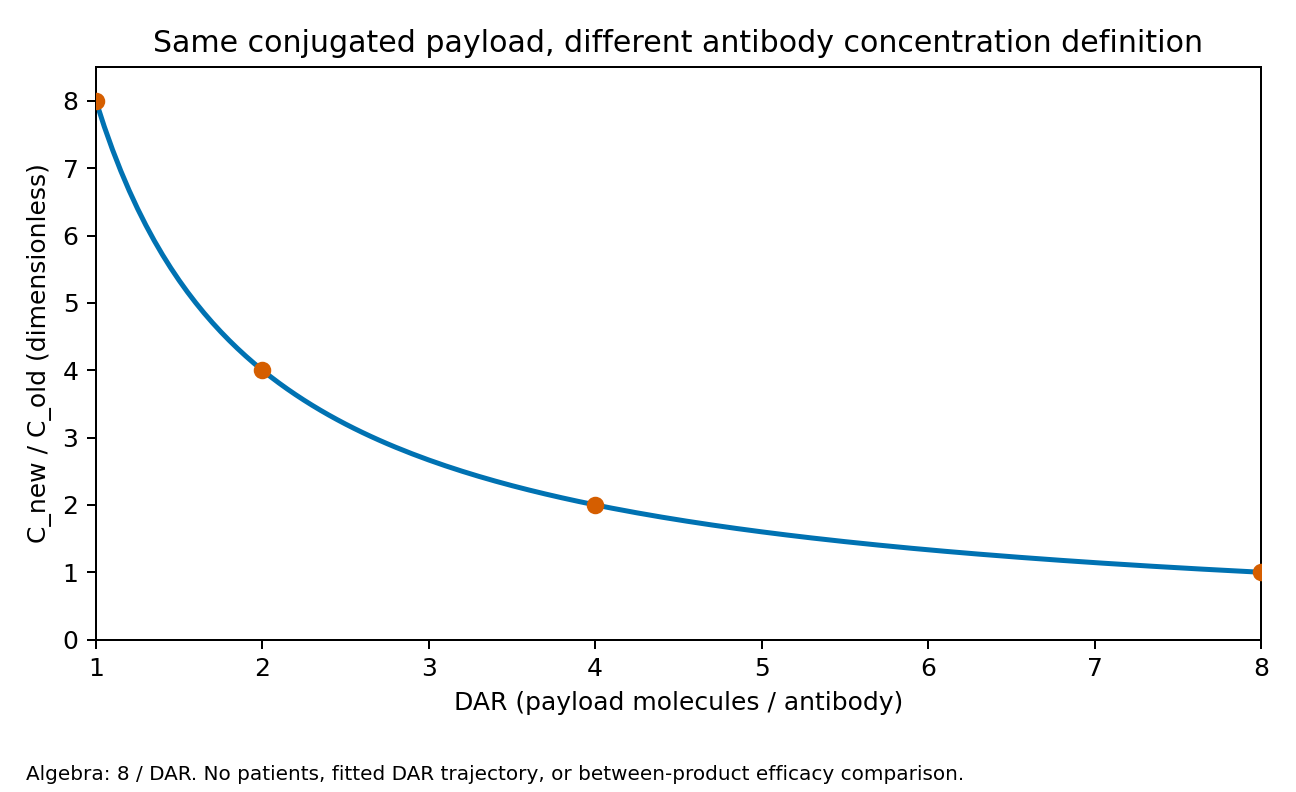
Figure 2. Algebraic \(8/DAR\) for fixed conjugated payload; no patient data or estimated DAR trajectory is plotted.
If half the integrated conjugated payload lies at DAR=8 and half at DAR=2, the ratio is 2.5. Fixing DAR to the equally weighted mean of 5 instead gives 1.6. The same mean DAR does not produce the same AUC conversion. This verifies a nonlinear transformation; it is not a patient model reproducing the label's 2.136-fold difference.
Analytes and integration windows across drugs
In the comparison in Table 2, the Dato-DXd paper measures ADC and released DXd in plasma, unlike SG's serum measurements and derived ADC concentration (1, 5). “Free payload” means unconjugated to antibody; it does not mean unbound to plasma proteins.
Table 2 Analytes and exposure definitions for SG and Dato-DXd
| Item | SG | Dato-DXd | Remaining comparison issue |
|---|---|---|---|
| Payload | SN-38 | DXd | Different potency and intracellular kinetics |
| ADC concentration | Derived from conjugated SN-38; DAR assumption changed | ADC immunoassay | Measurement/derivation definitions and model versions |
| Payload AUC in public labels | 3,510 ng·h/mL over 0–168 h | 18 ng·day/mL, first-cycle AUC | Integration window and dosing history |
| Regimen | Days 1 and 8 of a 21-day cycle | Every 21 days | Number of doses and observation period |
The 18 ng·day/mL converts to 432 ng·h/mL. Identical units do not establish identical 168-hour integrals or bioactive exposure. Because the relevant Dato-DXd label table does not state the integration endpoint, I did not derive a 168-hour or 21-day mean from that row. Using the paper's cycle-1 measure would require alignment with its original definition and population (6).
The 0–168 h mean free-SN-38 concentration for SG can be calculated as 20.89 ng/mL. It is neither a whole-cycle mean nor a protein-unbound-SN-38 mean. A ratio of mass AUCs does not establish a ranking of intratumoral payload, efficacy or safety.
Metrics in exposure–response analyses
The SG mTNBC E–R paper selects treatment-average SG concentration for ORR/CR and average total-antibody concentration for OS/PFS (7). The 2026 Dato-DXd HR+/HER2− breast-cancer paper associates cycle-1 ADC AUC with OS, while its final PFS model selects baseline tumor size (8). The September 2026 NSCLC paper uses different ADC exposure metrics for OS, PFS and ORR (9).
The problem is not only different tumor types. Even within one drug, outcome, observation window and patient background affect the selected exposure metric. Treatment-average exposure incorporates interruptions, reductions and time to an event. An exposure association cannot be interpreted as the causal effect of increasing the same patient's dose. Nor can an E–R model selecting ADC exposure be reinterpreted as a common free-payload E–R relationship.
Discussion
Total antibody, conjugated payload and unconjugated payload are different analytes. Derived exposure changes with the conversion to ADC concentration and the handling of DAR. The SG example shows how borrowing AUC without aligning definitions and source versions can make different quantities look like the same target.
Protein-unbound fraction alone does not equate the intracellular activity or tumor delivery of different payloads. FDA ADC guidance also addresses multicomponent bioanalysis and E–R (10). This comparison establishes neither a common exposure target transferable to another ADC nor a recommended dose.
Limitations and calculation checks
Numerical results are in outputs/tables/, generated by analysis/01_audit.py; the Notebook calls the same functions. Transcription of label numbers is checked by assertions against the originals, with source SHA256 verification. Patient records, concentration histories, paired model estimates and intratumoral bioactive payload were not obtained. This does not validate PopPK predictive performance or cross-drug equivalence.
Published papers and regulatory assessments were compared directly. Their figures and tables are not reproduced or modified. Figures here are original calculations from public numbers and the stated algebra.
Conclusion
Identical AUC units do not establish a common exposure target when analytes, derivations and time windows differ. The SG reporting difference neither isolates a DAR effect nor demonstrates a temporal increase in patient exposure. It also does not justify converting aggregate values from two ADCs into a potency comparison.
Data and code availability
The ZIP of analysis functions and unit checks excludes source data and full-analysis reproduction materials. Constructed test cases verify the implementation, not clinical data validity.
References
- Sathe AG, Singh I, Singh P, Diderichsen PM, Wang X, Chang P, et al. Population Pharmacokinetics of Sacituzumab Govitecan in Patients with Metastatic Triple-Negative Breast Cancer and Other Solid Tumors. Clinical Pharmacokinetics. 2024;63(5):669–681. doi:10.1007/s40262-024-01366-3.
- European Medicines Agency. Trodelvy: assessment report on variation EMA/VR/0000312649. EMADOC-1700519818-3107530. 2026 May 21. Sections 2.3.2 and 2.3.4. Public assessment.
- DailyMed. TRODELVY (sacituzumab govitecan-hziy): US prescribing information [Internet]. Version 18, Table 9 [cited 2026 Oct 8]. Archived label.
- DailyMed. TRODELVY (sacituzumab govitecan-hziy): US prescribing information [Internet]. 2026; version 20, Table 13 [cited 2026 Oct 8]. Archived label.
- Hong Y, Peigné S, Pan Υ, Friberg Hietala S, McLaughlin A, Tajima N, et al. Population Pharmacokinetic Analysis of Datopotamab Deruxtecan (Dato- DXd ), a TROP2 -Directed Antibody-Drug Conjugate, in Patients With Advanced Solid Tumors. CPT: Pharmacometrics & Systems Pharmacology. 2025;14(12):2149–2160. doi:10.1002/psp4.70118.
- DailyMed. DATROWAY (datopotamab deruxtecan-dlnk): US prescribing information [Internet]. Revised 2026 May, Table 10 [cited 2026 Oct 8]. Label.
- Sathe AG, Diderichsen PM, Fauchet F, Phan SC, Girish S, Othman AA. Exposure–Response Analyses of Sacituzumab Govitecan Efficacy and Safety in Patients With Metastatic Triple-Negative Breast Cancer. Clinical Pharmacology & Therapeutics. 2025;117(2):570–578. doi:10.1002/cpt.3495.
- Tang Z, Lim K, Jiang Y, Denduluri N, Rokutanda N, Pan Y, et al. Exposure-Response Analyses of Datopotamab Deruxtecan (Dato-DXd) in Patients with Hormone Receptor (HR) Positive, Human Epidermal Growth Factor Receptor 2 (HER2)-Negative Breast Cancer. The Journal of Clinical Pharmacology. 2026;66(4):e70188. doi:10.1002/jcph.70188.
- Hong Y, Mc Laughlin AM, Pan Y, Hietala SF, Peigné S, Chargualaf M, et al. Exposure-Response Analyses of Datopotamab Deruxtecan (Dato- DXd ), a TROP2 -Directed Antibody-Drug Conjugate, in Advanced Non-small Cell Lung Cancer. Clinical Pharmacology & Therapeutics. 2026 [published online 2026 Sep 13]. doi:10.1002/cpt.70477.
- US Food and Drug Administration. Clinical Pharmacology Considerations for Antibody-Drug Conjugates: Guidance for Industry. 2024 Mar. Final guidance.